
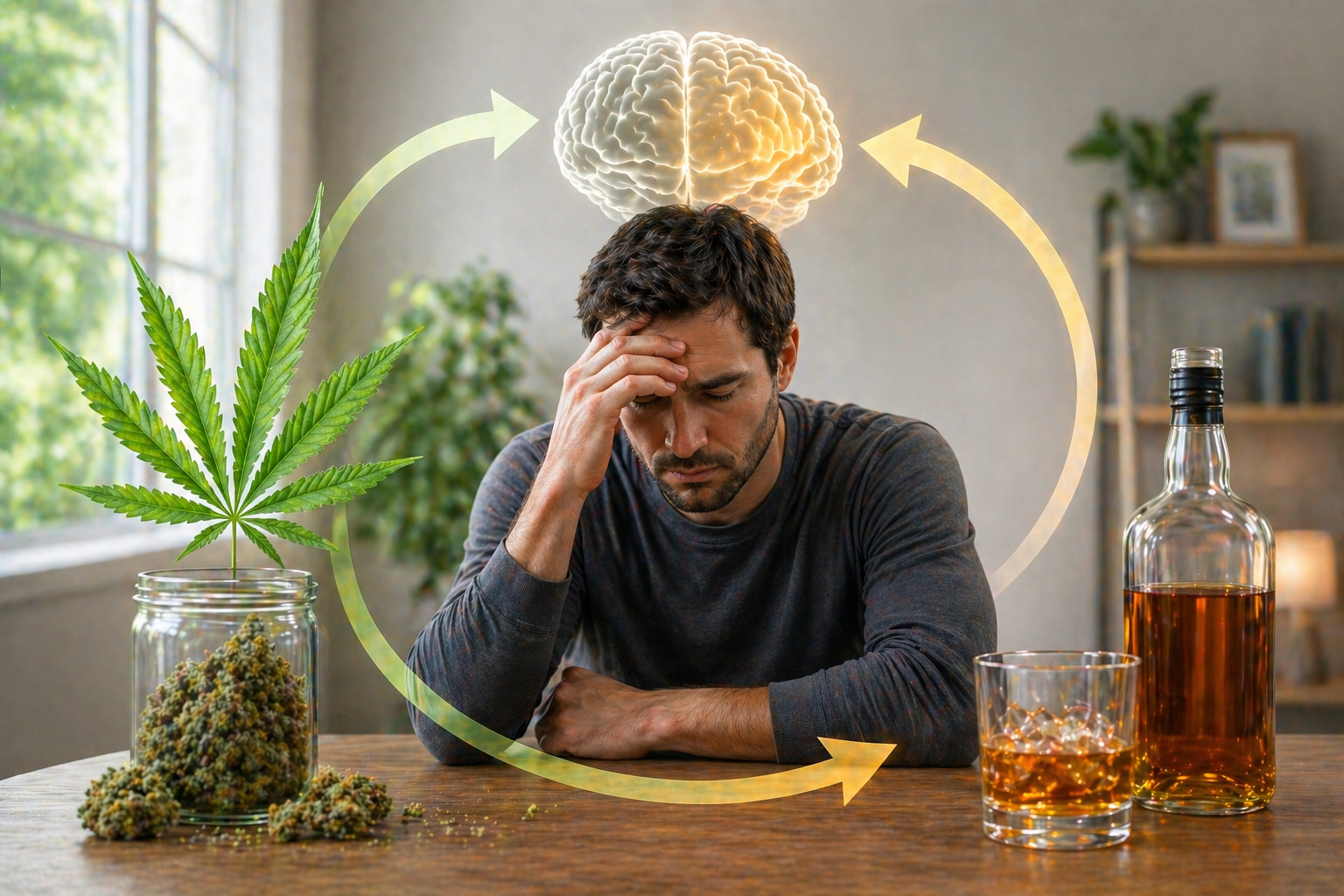
People with Alcohol Use Disorder often also use cannabis. This is called co-use or polysubstance use. Studies show that individuals with AUD are significantly more likely to use cannabis than the general population.
Sources:
Yurasek AM, Aston ER, Metrik J. "Co-use of Alcohol and Cannabis: A Review." Current Addiction Reports (2017). https://pmc.ncbi.nlm.nih.gov/articles/PMC7363401/
Haberstick BC et al. "Prevalence and Correlates of Alcohol and Cannabis Use Disorders." https://pmc.ncbi.nlm.nih.gov/articles/PMC3963405/
2. Three main ways they may interact
a) Substitution (using cannabis instead of alcohol)
Some people reduce alcohol consumption by using cannabis instead.
This can sometimes lower alcohol intake and related harms.
However, it may lead to Cannabis Use Disorder if cannabis use becomes problematic.
Sources:
Lucas P, et al. "Reductions in Alcohol Use Following Medical Cannabis Initiation." https://www.sciencedirect.com/science/article/abs/pii/S0955395920303017
Recovery Research Institute: "Can cannabis substitute for alcohol?" https://www.recoveryanswers.org/research-post/can-cannabis-substitute-alcohol-people-receiving-treatment-reduce-drinking/
National Center for Complementary and Integrative Health (NCCIH): https://www.nccih.nih.gov/health/cannabis-marijuana-and-cannabinoids-what-you-need-to-know
CDC Cannabis Information: https://www.cdc.gov/cannabis/about/index.html
b) Complementary use (using both together)
Others use cannabis alongside alcohol.
This can increase intoxication and impair judgment more than either substance alone.
It is associated with higher risks of accidents, impaired driving, risky behaviors, and alcohol-related consequences.
Sources:
Yurasek AM, Aston ER, Metrik J. https://pmc.ncbi.nlm.nih.gov/articles/PMC7363401/
Hasin DS, et al. "Cannabis Use, Cannabis Use Disorder, and Comorbid Psychiatric Illness." https://pmc.ncbi.nlm.nih.gov/articles/PMC7793504/
Cannabis Evidence Project: https://www.cannabisevidence.org/clinician-resources/clinician-briefs/cannabis-and-alcohol-use/
Psychological Science: "Combining Cannabis and Alcohol Amplifies Crash Risks." https://www.psychologicalscience.org/news/motr/combining-cannabis-and-alcohol-amplifies-crash-risks.html
c) Cross-sensitization
Both substances affect the brain’s reward system, including dopamine pathways.
Using one substance may increase craving or sensitivity to the other.
This may make quitting either substance more difficult.
Sources:
Yurasek AM, Aston ER, Metrik J. https://pmc.ncbi.nlm.nih.gov/articles/PMC7363401/
Metrik J, et al. "Acute Effects of Cannabis on Alcohol Craving and Consumption." American Journal of Psychiatry (2026). https://psychiatryonline.org/doi/10.1176/appi.ajp.20250115
Columbia University Medical Center: https://www.cuimc.columbia.edu/news/latest-research-shows-marijuana-use-may-be-gateway-relapse
3. Effects on the brain and behavior
Alcohol and cannabis affect overlapping neurological systems.
Alcohol: depresses the central nervous system, impairing coordination, reaction time, and decision-making.
Cannabis affects memory, attention, perception, and motivation.
Together, they can:
Worsen cognitive impairment.
Increase risk of dependency and substance use disorders.
Heighten anxiety, depression, or other psychiatric symptoms in some individuals.
Sources:
NIAAA: https://www.niaaa.nih.gov/
CDC Cannabis Information: https://www.cdc.gov/cannabis/about/index.html
NCCIH Cannabis Information: https://www.nccih.nih.gov/health/cannabis-marijuana-and-cannabinoids-what-you-need-to-know
Yurasek AM, Aston ER, Metrik J. https://pmc.ncbi.nlm.nih.gov/articles/PMC7363401/
4. Mental health connections
Co-use is linked with:
Higher rates of anxiety and depression.
Greater severity of substance use disorders.
More difficulty achieving positive treatment outcomes.
Sources:
Hasin DS, et al. https://pmc.ncbi.nlm.nih.gov/articles/PMC7793504/
Kelly TM, Daley DC. "Integrated Treatment of Substance Use and Psychiatric Disorders." https://pmc.ncbi.nlm.nih.gov/articles/PMC3753025/
Subbaraman MS et al. "Cannabis Use During Treatment for Alcohol Use Disorders Predicts Alcohol Treatment Outcomes." https://pubmed.ncbi.nlm.nih.gov/27865015/
5. Treatment implications
For people with AUD:
Cannabis use can help, hinder, or complicate recovery depending on the frequency and pattern of use.
Research suggests cannabis use during alcohol treatment may be associated with poorer alcohol-abstinence outcomes in some individuals.
Integrated treatment approaches that address multiple substance-use issues simultaneously generally produce better outcomes than treating them separately.
Sources:
Subbaraman MS, et al. https://pubmed.ncbi.nlm.nih.gov/27865015/
Subbaraman MS, et al. https://pmc.ncbi.nlm.nih.gov/articles/PMC11347081/
Kelly TM, Daley DC. https://pmc.ncbi.nlm.nih.gov/articles/PMC3753025/
Bottom Line
There is no one-size-fits-all answer:
Cannabis may reduce alcohol use for some individuals.
For others, it may increase risk and worsen treatment outcomes.
Overall, regular combined use of alcohol and cannabis is associated with greater impairment, more alcohol-related consequences, increased risk-taking, and more complex recovery challenges than using either substance alone.
Key References
1. Co-Use of Alcohol and Cannabis: A Review https://pmc.ncbi.nlm.nih.gov/articles/PMC7363401/
2. Cannabis Use During Treatment for Alcohol Use Disorders Predicts Alcohol Treatment Outcomes https://pubmed.ncbi.nlm.nih.gov/27865015/
3. Cannabis Use, Cannabis Use Disorder, and Comorbid Psychiatric Illness https://pmc.ncbi.nlm.nih.gov/articles/PMC7793504/
4. CDC Cannabis and Public Health https://www.cdc.gov/cannabis/about/index.html
5. National Institute on Alcohol Abuse and Alcoholism (NIAAA) https://www.niaaa.nih.gov/
6. Integrated Treatment of Substance Use and Psychiatric Disorders https://pmc.ncbi.nlm.nih.gov/articles/PMC3753025/
Cannabis Usage and the Relationship with AUD
The relationship between Alcohol Use Disorder (AUD) and cannabis use is complex, and researchers are still determining exactly how they influence one another. Here’s a clear breakdown:
1. Co-use is common