

Spirituality
The terms religion and spirituality are closely related but not identical. Scholars in psychology, sociology, and religious studies commonly distinguish religion as an organized system of beliefs and practices, while spirituality is often described as a more personal search for meaning, purpose, or connection to something transcendent.
Core Difference
Religion
Religion is generally understood as an organized and structured system of beliefs, values, rituals, and practices shared by a community or group. Sociologists and religious scholars note that religions typically involve institutions, sacred texts, moral teachings, traditions, and collective worship.
Common elements of religion include:
Formal institutions (church, mosque, temple, synagogue, etc.)
Shared beliefs and doctrines
Rituals, traditions, and moral guidelines
Community worship and identity
Examples include:
Christianity
Islam
Hinduism
Buddhism
Judaism
Strengths often associated with religion:
Provides moral guidance and ethical structure
Builds community and social belonging
Preserves traditions and shared meaning over time
Limitations sometimes identified:
Can feel restrictive or overly institutional to some individuals
May emphasize rules or doctrine more than personal experience
Spirituality
Spirituality is commonly described as an individual and personal experience of meaning, purpose, inner peace, or connection to something greater than oneself. Researchers note that spirituality may or may not involve participation in organized religion.
Common elements of spirituality include:
Personal inner exploration
Connection to nature, humanity, the universe, or a higher power
Reflection, mindfulness, or meditation
Flexible and individualized beliefs
Examples may include:
Meditation practices
Mindfulness
Personal prayer
Belief in universal interconnectedness
A personal relationship with God outside organized religion
Strengths often associated with spirituality:
Encourages self-awareness and personal growth
Flexible and adaptable
Can foster inner peace and meaning
Limitations sometimes identified:
May lack structure or accountability
Can feel vague or inconsistent without shared guidance
Aspect
Nature
Authority
Practices
Flexibility
Primary Focus
Religion
Organized and collective
External (texts, leaders, traditions)
Rituals, ceremonies, worship
Often structured or fixed
Shared belief systems
Spirituality
Personal and individual
Internal (personal insight and experience)
Meditation, reflection, mindfulness
Highly flexible
Personal experience and meaning
Can they overlap?
Yes—very often.
A religious person can also be deeply spiritual.
A spiritual person may not follow a formal religion.
Some people move from organized religion toward spirituality, while others move in the opposite direction.
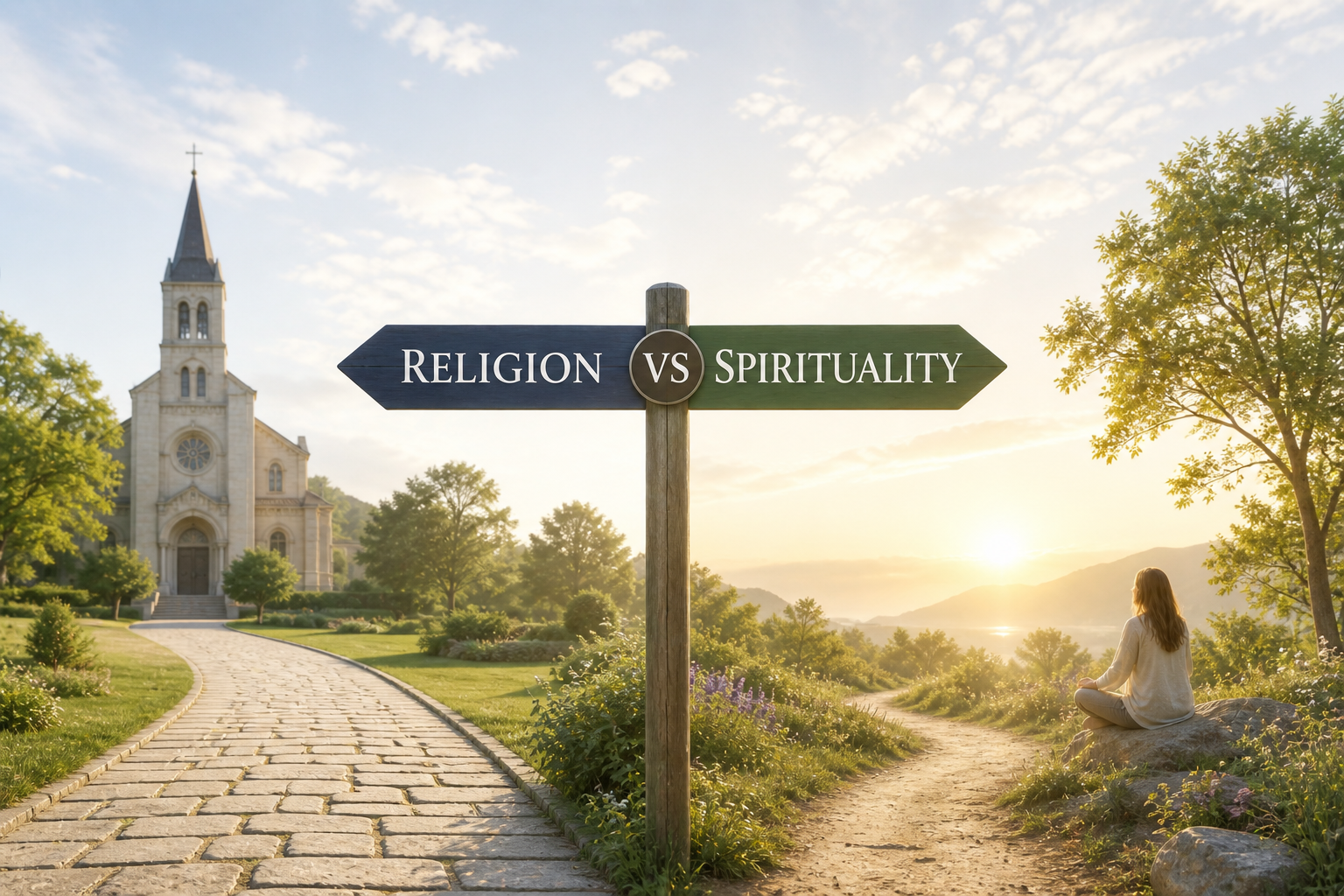
Simple way to remember
Religion = “belonging to a path”
Spirituality = “walking your own path”
Sources
Verywell Mind – Religion vs. Spirituality
Harvard T.H. Chan School of Public Health – Religion and Spirituality in Health
Sister Catherine Patrice on Spirituality
Sister Catherine Patrice on Spirituality.